For many people in Southwest Florida, golf is much more than a hobby — it’s a way to stay active, socialize with friends, and enjoy retirement.
Unfortunately, it’s also one of the sports in which back pain is most common.
Studies estimate that low back pain accounts for approximately 18–36% of all golf-related injuries, making it one of the leading reasons golfers miss time on the course.¹
The encouraging news is that golf itself isn’t usually the problem.
More often, back pain develops because of a combination of swing mechanics, limited mobility, reduced strength, and repeatedly placing excessive stress on the spine.²
Below are seven common swing characteristics that may increase stress on your lower back — and what you can do instead.
1. Swinging Mostly With Your Lower Back Instead of Your Hips
The golf swing should distribute motion throughout the body.
When the hips and thoracic spine (mid-back) don’t move well, the lower back often compensates by rotating more than it was designed to.³
Over hundreds of swings, that repeated stress can contribute to irritation of the joints, muscles, discs, and surrounding tissues.
What may help
- Improve hip mobility
- Increase thoracic spine rotation
- Strengthen your glutes and core
- Work on sequencing rather than forcing more backswing
2. Limited Hip Rotation
Healthy hip rotation allows your body to generate power efficiently.
When the hips become stiff, golfers frequently compensate by twisting through the lumbar spine instead.⁴
Research has found that reduced hip mobility is associated with an increased likelihood of low back pain in golfers.⁴
What may help
- Hip mobility exercises
- Rotational stretching
- Single-leg balance training
- Glute strengthening
3. Poor Core Endurance
Your core isn’t just your abdominal muscles.
It includes the muscles surrounding the spine, pelvis, diaphragm, and hips that work together to stabilize your body during movement.⁵
If these muscles fatigue quickly, your spine may absorb more stress throughout an 18-hole round.
Core endurance — not simply core strength — plays an important role in spinal stability during rotational sports.⁵
What may help
Focus on exercises that improve endurance, such as:
- Modified planks
- Bird dogs
- Side planks
- Pallof presses
- Farmer carries
4. Trying to Swing Harder Instead of More Efficiently
Many golfers believe that swinging harder automatically creates more distance.
In reality, efficient sequencing often generates more clubhead speed while placing less stress on the spine.⁶
When golfers “muscle” the club with excessive effort, they frequently lose balance, increase lumbar extension, and overload the lower back.
What may help
Work on:
- Tempo
- Balance
- Weight transfer
- Ground force production
- Proper sequencing
Distance is often a byproduct of efficiency rather than effort.
5. Poor Warm-Up Before Your Round
Walking directly from the parking lot to the first tee may leave your body unprepared for the demands of the golf swing.
Research suggests that dynamic warm-ups can improve mobility, muscle activation, and movement readiness before activity.⁷
Consider including:
- Hip rotations
- Thoracic rotation exercises
- Bodyweight squats
- Walking lunges
- Shoulder mobility drills
- Light practice swings
Even five to ten minutes can make a meaningful difference.
6. Playing Through Pain
Many golfers assume soreness is simply “part of getting older.”
While occasional muscle fatigue after a round may be expected, persistent or worsening back pain deserves attention.¹
Ignoring symptoms may alter swing mechanics, reduce performance, and increase stress on other areas of the body.
If pain continues despite rest or begins interfering with everyday activities, a professional evaluation is appropriate.
7. Forgetting That Golf Is an Athletic Activity
Many golfers don’t think of themselves as athletes.
But the golf swing generates substantial rotational forces through the spine.²
Preparing for golf should include more than just practicing your swing.
A well-rounded program should address:
- Strength
- Mobility
- Balance
- Power
- Endurance
- Recovery
Improving overall fitness often benefits both performance and long-term health.
Does Every Golfer With Back Pain Need an MRI?
Not necessarily.
Many golfers are surprised to learn that MRI studies frequently identify disc bulges, arthritis, and degenerative changes in people who have no back pain at all.⁸
Imaging is valuable in certain situations, but current clinical guidelines recommend that treatment decisions be based on the complete clinical picture rather than imaging findings alone.⁹
A comprehensive movement assessment often provides important information about how your body is moving during everyday activities and sports.
How Can Physical Therapy Help Golfers With Back Pain?
An individualized evaluation can help identify factors that may be contributing to pain, including:
- Limited hip mobility
- Reduced thoracic rotation
- Decreased core endurance
- Balance deficits
- Swing-related movement patterns
- Strength limitations
Treatment may include:
- Therapeutic exercise
- Manual therapy
- Functional movement retraining
- Balance training
- Mobility exercises
- Progressive strengthening
- Golf-specific movement education
The goal isn’t simply to reduce pain — it’s to help you return to golf with greater confidence and efficiency.
How We Help at Kriz Mobility and Vitality
At Kriz Mobility and Vitality, we enjoy helping golfers continue playing the game they love.
Our comprehensive evaluation looks beyond the location of your pain to identify the movement patterns, strength deficits, mobility limitations, and functional restrictions that may be contributing to your symptoms.
Because Dr. Mike Kriz is a Titleist Performance Institute (TPI) Medical Level 2 Certified provider, golf-specific movement assessments are incorporated when appropriate to better understand how your body moves throughout the swing.
Depending on your examination findings and goals, your individualized rehabilitation program may include:
- Golf-specific movement assessment
- Therapeutic exercise
- Manual therapy
- Functional movement retraining
- Balance and stability training
- Hip and thoracic mobility exercises
- Neuromodulation, radial shockwave therapy, or photobiomodulation when clinically appropriate as part of a comprehensive rehabilitation program
Whether your goal is to play 18 holes comfortably, increase your driving distance, or simply enjoy golf without worrying about your back, our focus is helping you move more efficiently and stay active for life.
A TPI Screen Is Not About Fixing Your Swing — It’s About Understanding Your Body
A common misconception is that a Titleist Performance Institute (TPI) screen is designed to correct your golf swing. In reality, it does something different: it looks at your body, not your technique.
A TPI assessment evaluates the physical building blocks that support an efficient, comfortable swing — including mobility, stability, balance, strength, and coordination. The goal is to identify whether a physical limitation, rather than a technical flaw, may be influencing your swing mechanics or contributing to discomfort.
Importantly, a TPI screen does not replace instruction from your golf professional. Instead, it complements that coaching. If your golf pro identifies a swing pattern that isn’t changing despite instruction, a TPI screen can help determine whether an underlying physical restriction — such as limited hip rotation or reduced thoracic mobility — may be part of the reason why.
This distinction is part of what makes our approach at Kriz Mobility and Vitality unique: we’re not here to teach you golf swing mechanics. We’re here to help your body move the way it needs to in order to support the swing you and your instructor are working on together.
Frequently Asked Questions
Is golf bad for your back?
Not necessarily. Golf is a physically demanding rotational sport, but many people continue playing comfortably for decades with appropriate mobility, strength, conditioning, and swing mechanics.²
Why does my back hurt after playing golf but not during the round?
Symptoms often develop after repetitive loading, when muscles begin to fatigue or irritated tissues become more sensitive following activity.¹
Can stretching alone prevent golf-related back pain?
Stretching can improve mobility, but research suggests that combining mobility, strength, endurance, balance, and movement training provides the greatest benefit.⁵
Should I stop golfing if my back hurts?
Not always. Many golfers are able to continue playing with temporary activity modifications and an individualized rehabilitation program. Persistent or worsening symptoms should be evaluated by a qualified health care professional.⁹
Download Our Free Back Pain Guide
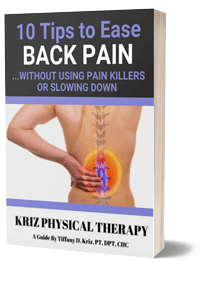
If back pain is affecting your golf game, download our Free Back Pain Guide to learn more about common causes of back pain after age 50, evidence-based treatment options, and practical strategies that may help you stay active on and off the course.
Schedule a Complimentary Telephone Consultation
If back pain is keeping you from enjoying golf, our team at Kriz Mobility and Vitality is here to help. Schedule a complimentary telephone consultation to discuss your symptoms, ask questions, and learn how an individualized evaluation may help you return to the activities you enjoy.
References
1. McHardy A, Pollard H, Luo K. Golf Injuries: A Review of the Literature. Sports Medicine. 2006;36(2):171-187.
2. Lindsay DM, Horton JF. Comparison of Spine Motion in Elite Golfers With and Without Low Back Pain. Journal of Sports Sciences. 2002;20(8):599-605.
3. Gulgin H, Armstrong C, Gribble P. Weight-Bearing Hip Rotation Range of Motion in Female Golfers. North American Journal of Sports Physical Therapy. 2010;5(2):55-62.
4. Vad VB, Bhat AL, Basrai D, et al. Low Back Pain in Professional Golfers: The Role of Associated Hip and Low Back Range-of-Motion Deficits. American Journal of Sports Medicine. 2004;32(2):494-497.
5. George SZ, Fritz JM, Silfies SP, et al. Interventions for the Management of Acute and Chronic Low Back Pain: Revision 2021. Journal of Orthopaedic & Sports Physical Therapy. 2021;51(11):CPG1-CPG60.
6. Titleist Performance Institute. Body-Swing Connection and Golf Biomechanics. (Educational concepts consistent with TPI screening and movement principles; not a peer-reviewed publication.)
7. Fradkin AJ, Sherman CA, Finch CF. Improving Golf Performance With a Warm-Up Conditioning Programme. British Journal of Sports Medicine. 2004;38(6):762-765.
8. Brinjikji W, Luetmer PH, Comstock B, et al. Systematic Literature Review of Imaging Features of Spinal Degeneration in Asymptomatic Populations. American Journal of Neuroradiology. 2015;36(4):811-816.
9. Qaseem A, Wilt TJ, McLean RM, Forciea MA; Clinical Guidelines Committee of the American College of Physicians. Noninvasive Treatments for Acute, Subacute, and Chronic Low Back Pain: A Clinical Practice Guideline From the American College of Physicians. Annals of Internal Medicine. 2017;166(7):514-530.
This material is educational in nature and is not a substitute for individualized medical advice, diagnosis, or treatment. Consult a qualified health care provider with any questions regarding a medical condition.